01
Developmental
Structure, pacing, promise, and big-picture story decisions.


Professional book editing that strengthens story, sentence, and market readiness—with clear notes you can act on.
Demonstrative before-and-after lines—not client manuscripts—so you can feel the shift in clarity and tension.
She was very afraid as she walked into the room.
She entered the room, trembling.
Editing process
Developmental through proof—scoped to where the manuscript is, not a one-size stack of edits.
Structure, pacing, promise, and big-picture story decisions.
Voice, rhythm, imagery, and sentence-level strength.
Grammar, consistency, and a living style sheet.
Final-pass polish before print or digital release.
THE EDIT
A letter on structure, voice, pacing, and what to fix first.
Tracked changes at the edit level you and we agreed.
Names, tense, and house choices so the book stays consistent.
The next revision, ranked so polish never precedes story.
WHERE IT SITS
Partnership built around authorship—clear roles, shared checkpoints, and a manuscript that still sounds like you.
Audience
When structure, promise, or pacing is still moving, the first pass is about the book as a whole.
Outcome
When the story holds, line editing, copy editing, or a proof can be the whole engagement.
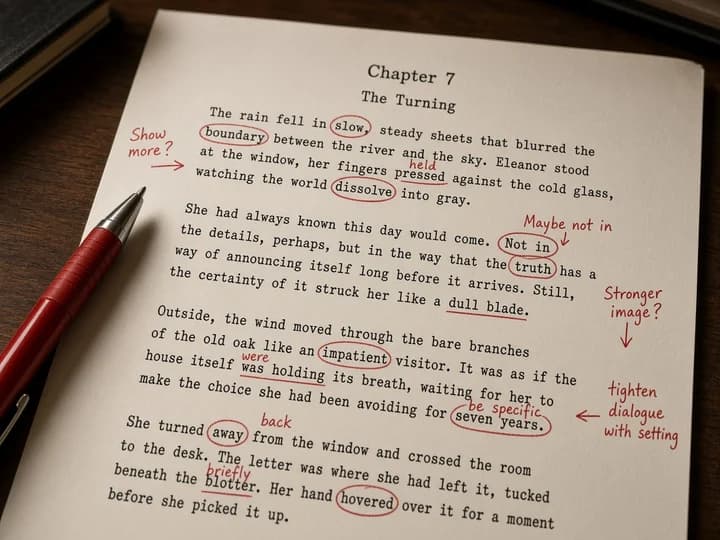 Sample concept
An illustrative marked-up page showing the clarity and care our edits aim for. Real client pages stay confidential.
Clear rationale
Notes explain the why—so revisions stay intentional, not noisy.
Line-level lift
Rhythm, clarity, and tension tightened without flattening voice.
CLIENT VOICES
CoreSphere caught my voice in the first draft batch. The manuscript finally sounds like me—only clearer, tighter, and ready to share.
Elena Marquez
Memoir author
01 / 05
FAQS
Process, involvement, confidentiality, and scope—clear answers before we open the manuscript conversation.
If structure and pacing need work, start developmental. If the story is solid, line or copy editing may be enough. We recommend after a short sample review.
Yes. Approach and checklists adapt to narrative form, genre conventions, and publishing goals.
Scope is agreed up front. Most packages include a primary edit pass plus a clarification review call.
Many clients continue into publishing guidance or trailer development once the manuscript is stable.
Start a conversation
Share the draft, the idea, or the unfinished chapter. We reply with a clear next step—quiet, specific, no pitch theater.
Ghostwriting, fiction, editing, or publishing—tell us where the pages stand.